


After the record-shattering 20 likes on my first post, Poetry Books I Read & Liked, I’m back to do it again! (Some of these aren’t poetry, strictly.)
Tom Cole — Chimes: A Monologue (The Song Cave, 2026)
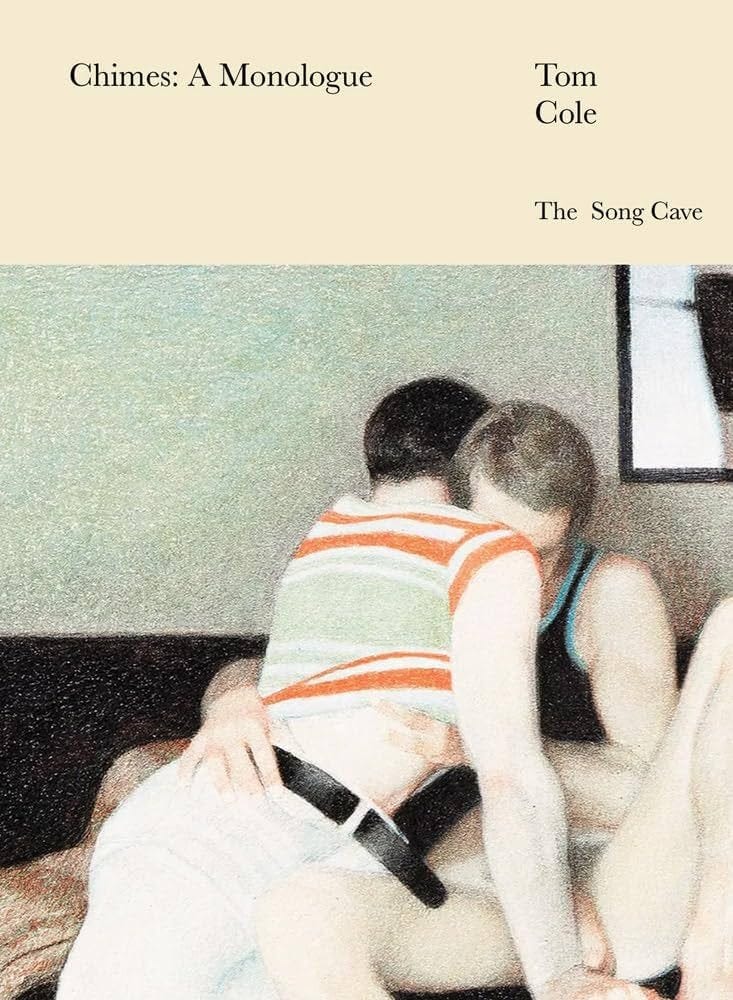
Do you love following a complicated, perverse, self-destructive, darkly funny voice of someone reckoning with their entire life and relationship to the world around them? In the words of Leonard Cohen, who I find a way to mention whenever possible: “You want it darker”?
If so, you’ll devour Chimes in a day or less, as I did. Or maybe it devoured me; I may actually be writing from inside the startling black hole that Cole created. Leapt into it gladly.
It’s a one-man play, a long poem, a slanted memoir. Manic, frank, and intensely intimate, Chimes reeled me back to those long, long months of pandemic lockdown in which we were each uniquely and simultaneously losing our shit: Ruminating about ex lovers. Worrying about death in brand new and resurfaced ways, like relapses into one or more life-threatening proclivities. Disdain at the wealthy for fleeing, for how they casually abandon any sense of the collective, if they ever had it, once the city ceases to entertain.
Little else to do but reminisce and recollect the dredged-up sludge at the floor of one’s subconscious. And forget how to act. See: the titular chimes. See also: a story involving a bougie baby pram “completely inappropriate for the city”, which I won’t spoil for you.
I was delighted by this book’s metapoetic flourishes, its depraved humor and candor. Here’s one scene, following one in which the speaker sent a “request for a beating, a formal letter” (included in the book, of course) to a man online:
“Tattomuscledad told me he had testicular cancer, also was sore because Michigan had the sub-master taser his balls 15 times, all broadcast on Skype—it really hurt and he felt Michigan was trying to ruin his relationship with the sub-master who used to be his slave (and was, in fact, his longtime lover of 20 years) but he was going with it because Tattoomuscledad and the sub-master lived together and really couldn’t afford to separate.
Typical New York real estate story.”
In a different scene (the speaker’s so deliriously sexually omnivorous that sometimes I can’t untangle escorting work from dates—but maybe that’s the point!), while enacting a complicated dom/sub dynamic while dressed as a cop and also performing as a maid: “The salad had alfalfa sprouts on it and they started talking about musical theater.
And I thought—WHAT IS THE SAFE WORD.”
This is a book for people who relate to not asking for the safe word.
Luke O’Neil — We Had It Coming: And Other Fictions (OR Books, 2025)
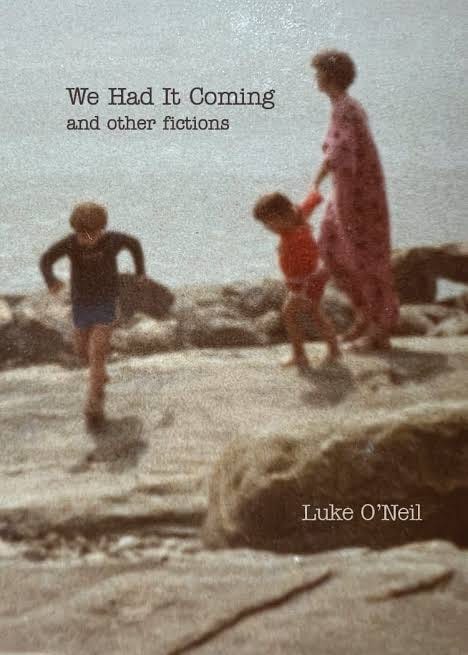
This collection blends short stories, poetry, micro-fiction (whatever they’re calling it these days, can’t say I’m keeping track), and the personal into a perpetual stew.
I’m invoking perpetual stew in part because the book is so hyper-present, like it could just keep going past its 300-some pages into right this second. And because of how it gestures toward the commons and the communal. I was just telling a mutual writer friend (hi, Rax!) how this book made me cry a bunch, how O’Neil’s cadence and way of noticing lodged in me—which full circled into thinking about how good it was to see my friend, it’d been a while.
I lingered in conversations longer just to be there. I texted a friend first, knowing that inviting him to hang would mean talking about how he just watched someone he loves die. I called my dad. I called my dad, again, because he’s 77 and just got out of the hospital, again. I sent sentimental texts to people right after we parted, which I like to think I usually do but that’s not true. I tried to be where I was. Stood at sinkholes (there are so many in Philly right now, good lord) and peered in all differently. When did that cow sculpture above someone’s door on 8th and Washington get there? Huh.
I don’t know if O’Neil self-identifies as a poet (is that like self-identifying as a flight risk or fragile cargo…), but only a poet is capable of this sort of Seeing. The infinitesimally quotidian moments in one person’s life, and the wider lens on contemporary reality.
Such close attention, but also the kind that seems baffled, always, like it’s their first time being alive on earth… Waaiiit a minute.
It barely makes sense to us now, right? How can we metabolize a livestreamed genocide and keep doing whatever we’re doing? O’Neil writes, “Maybe if certain things go well just after the next election they might take action to save you. You who have already been burned.”
Here’s an exasperated, cuttingly funny observer reporting on a reality in which “[t]he most illiterate fascists alive were gassing themselves up because the computer had gotten some small degree better at producing dog shit that had the general production values of a circa 2004 video game cutscene. Delighting in the approach of a spiritually and culturally dead future devoid of art and meaning.”
What else? Everyone you love is dead or dying; middle age is strange: “Not old enough that the kids have come to the realization that they better ask you questions about your life for the first time ever before it’s too late and not young enough that everything you do is being recorded at all times.”
And beautiful and insistent, too, in saying look we’re alive. This book, in the wry vernacular of someone raised by the Internet (same here), had me all rattled about that. Necessarily.
Emily Holland — Notifications On (out in January 2027 from Washington Writers’ Publishing House, preorderable now)
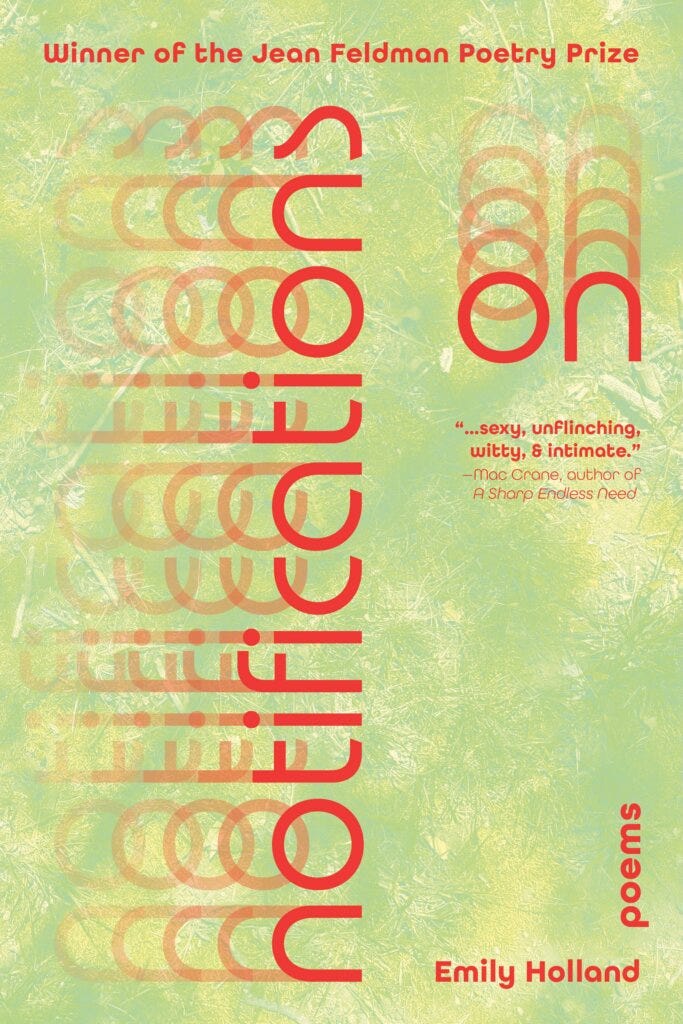
There’s a line from Maggie Nelson’s Bluets (stay with me here, okay) that I’ll admit to hanging in my internet locker once upon a time: “Do not, however, make the mistake of thinking that all desire is yearning.” What did I hope to broadcast about my desires with this alignment? (That section was about a Goethe painting, if I recall correctly, but also? Knowing now who the speaker was so heartbroken about, I’m like… I don’t align with your scope of desire at all, Maggie Nelson.)
Emily Holland’s debut full-length collection foregrounds the intensity of their speaker’s yearnings in all its multiplicities and complications. This collection is a perceptive, tender, cheeky (“I think I’m a bad lesbian because I don’t know much about the moon and stars”) rumination on queer desire, love, and lesbian representation and cultural touchpoints (one of my favorites is a response to Zoe Leonard’s infamous text work, “I want a dyke for president”) in our era of the ever-present Devices. Which is also the era of the ever-fragmenting performance of Self.
“Every two hours, my / phone vibrates, begging for an interaction.” Equally intrusive is the carnal mode and its urgencies. Foregoing poetry itself, even! “Sometimes I just want to fuck without feeling the need to write about it.”
So much in these poems elicits desire for the speaker: persimmons, fog, “the high desert / mountains and their lilac blessing on the horizon,” Emily Dickinson’s grave. The energy is restless and conflicted at turns, decadent and languorous at others. No ta-da moments of revelation or tidy conclusions here, blessedly. When Holland writes, “I want to keep wanting,” that’s the orientation to desire that I actually recognize.
This post got me excited about all three books, your words for each made it so! & even more so for a new (debut) book for next year! 🙌🏽 I recently got my planner for 2027 and it’s nice to start putting down stuff on it to look forward to! 🤩
I will be borrowing that Tom Cole thank you